The short answer to the above question is no.
That's not my opinion, this is something that's been tested and shown to be demonstrably not true, and setting speed limits based on this belief is irresponsible and potentially dangerous!
There are several issues to do with speeding and speed limits I could write about, but first, I'll deal with this one.
I think tackling this should be less controversial and I need to get it off my chest as it's vacuous and I've come across police officers and driving instructors who believe it to be true, that's how endemic it is.
There doesn't seem to be a page on the internet that deals specifically with what is sometimes referred to as Speed Creep, so I feel duty-bound to be the person to create a take-down of this so that I and other people can direct people making that claim to it.
The idea is; some people are breaking the law, and the solution is to criminalise the behaviour of people not breaking that law, in order to stop people from breaking that law.
If you think that sounds like nonsense, then you'd be right.
This is called an appeal to the stone, but I will back up my claim.
While
I am saying speed limits should not be seen as traffic calming per se,
there is evidence to suggest that for what effect they do have on
traffic speeds, they are most effective when they match the road they're
on.
So, there is a nugget of truth to the idea, because posting a speed limit slightly below the engineering recommendations may lead to safer roads and fewer accidents.
The
lack of an option to set speed limits in 5mph increments is an issue there in
the UK.
What
I'm trying to tackle, is the trend to post speed limits far below that, with little or no appreciation given to the engineering standard, 85th percentile or even average
speed.
Just set the speed limit really really low, in the vain hope that
people who drive genuinely fast will only dare drive X or Y amount over the
speed limit.
Add to that, other unhelpful tactics like non-uniformity and limits that start and end in arbitrary locations rather than in-line with where the road changes in character, only help to increase speed limit apathy.

Radyr, Cardiff.
This is one of the worst examples of a 20mph speed limit I've seen in the UK.
This looks and feels like a 40-limit road, at least if they kept this section 30, there could be a drop in speed limit for traffic entering the built-up area.
People are speeding, so let's drop the speed limit?
If there's one phrase more than any other that is so wrong,
hearing it is like someone scraping their fingers down a
chalkboard, it's the phrase "we need to drop the speed limit to do something about people speeding" or derivatives of that.
It is, however, a highly intuitive-sounding solution, which I used to assume was true.
That was before I had any idea how or why
speed limits are set, or at least used to be, and what makes them effective.
The reason I want to write about this specifically is...
It's often so universally expected and accepted to be true, the first suggestion that it's not can result in derision.
This belief perseverance means people will swear blind that it's worked on a road near them, or it's different where they live etc. It's only when you look through the data from radar detection or ATCs shows it hasn't.
"It
is a common but mistaken belief that drivers allow themselves a set
margin over the prevailing speed limit, and that if a limit is raised by
10 mph, they will travel 10 mph faster. In fact, an increase in an
unrealistic speed limit rarely brings an increase in traffic speeds. It is much more likely that there will be no change,
or even a fall. It seems that drivers relieved of the frustrations of
too low a limit rarely abuse the higher one. " The DfT.
If you search for "speed limit campaign" now, you'll doubtless find many groups of angry locals posing by a roadside pointing at a sign desperately trying to get their speed limit lowered to "help deal with speeding".
It's just automatically assumed this will massively improve the safety of their road.
It's just assumed the safer speed limit will always be a lower one. In some cases it is, and in others, it isn't.
I think this belief seems to be the basis on which many speed limits are being lowered, and doing it is irresponsible and potentially dangerous.
I actually found one news article while researching this where someone has said the following.
"A 20mph limit is a great idea. They drive like bats out of hell through the Market Place and then up Spa Road – some cars are clearly doing speeds around 60mph. It’s ridiculous!"
Reading that did make me want to bang my head on a wall.
Another one I found was a 40 limit being extended after someone was killed by a drunk driver going 80mph!
If I were to teach people about setting speed limits, one of the first examples of how not to do it would be to just set the limit really low and hope for the best.
There have been studies on
the effectiveness of changing speed limits, and they have not concluded that by
setting the speed limit lower a large number of drivers will then drive 5 or
10mph over or under it, I have also found evidence myself locally to back that up.
On the contrary, according to that linked study, dropping the speed limit had no effect on the fastest 1% of drivers, while raising it had a very slight slowing effect on the fastest 5%.
Dropping the speed limit may drop average speeds slightly. Often on council websites, you may find it buried somewhere, what their optimistic expectation of an actual traffic speed drop is, maybe 1-2mph.
Even if that target is met, it's with the expectation that the average speed will then be over the speed limit, often substantially so.
The massive increase in non-compliance must be expected, like that could be seen as a good thing. That's what I can only describe as non-compliance by design, This is not a minor issue but a significant flaw in the system
The limit is set beyond its ability to function. Who
is the speed limit then able to single out or target? The short answer is no one, and that's only the first problem.
The drop in actual speeds is often nowhere near what many people expect, one poll showed that 1 in 6 people believe it to be 10mph. This is partially where the danger lies, and in some cases dropping the speed limit has even led to an increase in average speeds.
You might think this small drop in average speed is still worth it despite the massive increases in non-compliance, that's not a ridiculous position to take. However, this drop-in speed is largely not because the very fastest drivers are slowing down. This is where things start to get insidious.
It's the fastest drivers who are some of the least likely to pay any attention to lower posted speed limits, the most likely to do harm and the drivers who properly set speed limits are most efficient at targeting.
"You shouldn't be expecting average speeds to be over the limit, that's what I can only describe as non-compliance by design"
Unfortunately,
despite there being no evidence that this is how most people drive. The automatic
belief that this is the case is quite prominent and is increasingly being used
as a reason by councils to drop speed limits. Councils, rather than explaining to people
better why this is not the case and trying to educate people better as to the
intricacies and nuances that go into properly setting speed limits, or at least
were. They will go ahead and drop the speed limits anyway.
Often, this can be as
a result of a nasty accident involving a reckless, dangerous and/or drunk driver and often without
any changes to the engineering of the road or a without a demonstrable change to
its character.
In
some cases, when initially dropping the speed limit doesn't work, councils' only
recourse is to drop
it still further and move the boundaries back, that's when things
start to get absurd.
The speed limit can be so wide of the mark, it goes beyond just being a target
speed and some limits can bear little to no relationship to what most drivers would
perceive as a safe speed to travel, then you end up bringing limits
into contempt, and not taken seriously by the majority of drivers.
Many roads in Bristol have been shown to have non-compliance rates in excess of 90%, and that's several years after the speed limits were changed.
This is when you start to get to the point when far from helping to do
something about speeding, you have a limit that's about as effective as
not having a posted speed limit!
This has not stopped one councillor to suggest reducing the limit still further to 15mph.
Councils may deny, that the X over the speed limit hypothesis is behind the lowering of a speed limit and that the limit they have posted is genuinely the fastest speed a driver should be able to obtain safely under ideal conditions. However, I have seen councillors openly admit this is the case, and claim to be proud of it.
When the speed limit is so low that it's almost universally disobeyed, anyone attempting to drive at the speed limit increases their accident risk by driving significantly slower than the mean traffic flow.
Even the small drop in average speeds claimed may be exaggerated, if one car goes the speed limit and there are 4 behind it, that may count as 5 cars going that speed, but it's the free-flowing average speed of unimpeded traffic that is relevant.
This also will lead to an increase in deviations in traffic speeds meaning vehicles are more likely to bunch together, increasing accident risks and I've seen an increase in extremely dangerous overtaking manoeuvres.
If a road genuinely has an issue with a larger than the average number of drivers going faster than the engineering standard of that road, ie people are genuinely racing down it, more so than on other roads elsewhere of the same standard, then better enforcement of the existing speed limit is what is needed.
However,
if in that situation a councillor states they intend to drop the speed limit to
"deal with the issue" you should slap them around the face
because it's a scam, a con job and a cheap option from the councillors' book of
"How to Look Like We're Doing Something". Either they
don't know any better or worse they do.
In such a situation I would recommend objecting to the council's consultation by asking the following questions; "What is the drop in actual traffic speeds expected"? "Is the issue with speeds currently with people already going below the current speed limit or over it"? and "what engineering changes are proposed to go along with this speed limit drop"?
It's demonstrably not true that drivers who are prepared to drive a genuinely unsafe speed for the conditions only do so because the speed limit lets them and/or because it's only slightly over the speed limit, and if only the speed limit was lower they'd be sensible drivers.
What's the issue, do you just like to drive fast?
People often try and frame the debate with that question when I argue about this sort of thing, instead of addressing the argument I actually make.
This tactic is just criminalising normal driver behaviour of those attempting to do nothing more than drive to the prevailing conditions, which then helps to create apathy towards speed limits from the majority of motorists.
When people spend their life obeying the law, they’re bound
to become resentful if you keep changing the law so that their normal behaviour
would make them into a criminal.
Unfortunately,
as mentioned above, the actual traffic speed drop is only slight, so these schemes
may only help to make the most vulnerable road users such as pedestrians and cyclists become more complacent by giving them a false indication of actual traffic speed. Also, there's a cost to putting signs up, this could be put to use on actual physical changes to roads to make them safer to cross, like installing pedestrian refuge islands on busy faster roads, building cycle infrastructure, and/or redesigning roads in places to make them safer and so they intuitively encourage lower speeds.
The X amount over the speed limit belief is often so ingrained, you can explain to people that it's not the case, give evidence and tell them why, and some people still don't get it.
The Evidence.
Just to show you the level to which it's the road standard and not speed limits that dictate traffic speeds, I'll include some data I gathered from South Gloucestershire.
I initially filed an FOI request from them regarding the average speed on Shire Way and Heron Way in Yate because I wanted to know how much faster traffic was going on Shire Way than it was on Heron Way, as I suspected it might only be slightly faster.
I went to have a look at Heron Way and Shire Way for the purpose of this blog post.
The road on the left has a 30mph speed limit, and the road on the right has a 40mph speed limit but a lower actual speed.
On Shire Way, I didn't dare park on it, while on Heron Way I did. Not only on Shire Way are there only frontages on the one side for much of its length, but they are also set much further back, it has much more of the character of a road that you would expect to have faster speeds.
Heron Way has much more of a feeling of an ordinary residential street, with frontages much closer to the road and on both sides and many parked cars, also there were noticeably more people about.
Despite there being repeaters telling people and reminding them that they can go faster, and yet they're not. What could possibly be going on here, it's almost as if most people have an aversion to crashing or running people over.
They're two roads on the same estate, built to a very similar standard only Shire Way has a 30mph speed limit and only has frontages on one side for much of its length.
Even though I'd already read the study linked above I was not expecting the result I got, not only is the average speed significantly lower on Heron Way at 31mph, speeds were between 3 and 4mph faster on the 30-limit road, factor in the variance from the limit to the average speed it's a 13mph difference from -9 to +5mph from the speed limit.
I can only conclude that Heron Way is very much the safer road, it's lined with repeaters telling people they can go faster, and yet almost no one is.
This, however, didn't stop some residents who live on Heron Way from still calling for the limit to be lowered, once there was a story in the local paper resulting from my FOI request. I went on to do many more requests to find that many roads with 40mph speed limits have lower average speeds than other roads elsewhere in the county with 30mph speed limits.
It's a good thing though that people perceive 40 limits as making the road much more dangerous even if it's not, it will cause pedestrians to treat the road with more caution, which is partially why they exist, they don't increase traffic speeds by much, if at all.
One road, Bristol Road in Frampton Cotterell had 97% compliance with the speed limit before it was lowered according to the council's data. A 20mph street in Bristol (Pennywell Road) had 97% non-compliance according to a hidden camera placed there by the local paper, and the average speed was 8mph over the limit. I even know of a 40mph residential limit in Gloucester having a lower average speed than Pennywell Road.
Some people might state that study I linked to is not relevant because it's over 20 years old and from another country.
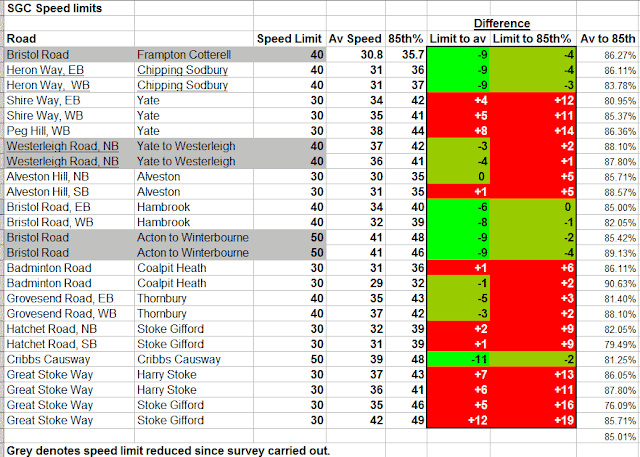
It's worth having a good look at this just to get to grips with the sheer level of discrepancy.
In South Gloucestershire, even a road with a 50mph speed limit had lower actual speeds both in terms of mean average and 85th percentile than at least one road with a 30mph speed limit. If you look at both roads on Streetview it becomes clear why. This goes to show it's the engineering standard that dictates speed.
I also filed another for roads in Cwmbran.
There should just be more enforcement and drivers should just get used to it.
That just shows a lack of understanding of how speed limits work and how we got current speed limits.
DfT guidelines state that limits should "encourage self-compliance" and "largely self-enforcing".
This method also relies on forcing people to drive slower by threatening to punish them, it's not making them more moral or better drivers, and it just encourages a drive-by-numbers mentality.
Don't concentrate at your speedo, look at the road ahead of you.
Too many people think that speed limits are there to generally dictate the speed most people drive at or under, and expect them to work like that.
Speed limits were introduced primarily as a legal tool, DfT guidelines still state that "Speed limits should be seen by drivers as the maximum rather than a target speed".
I understand that's how a lot of people would like them to work, but they don't, it's been shown not to even if you try. You have to act within the constraints of what works in reality.
Unfortunately, some people seem to not care that it's not the case they just think
it should be, so no amount of explaining how speed limits work makes a
difference. They seem content to set rules in denial of real-world human behaviour.
Finding new and innovative ways to shout "obey" to people isn't going to work.
Traffic speeds are overwhelmingly determined by the engineering standard of the road and the conditions at the time, not speed limits, that's just demonstrably the case.
Speed limits, for what difference they do make, are most effective when they match the road they're on. Exceptions to this need to be just that, exceptional, if they're realistically going to have any effect.
As one road engineer put it "If plenty of people are breaking a limit, that probably tells you either the limit is wrong, or the design of the street is wrong. Something has to give."
I can already tell, that some people are reading this and are about to comment on this along the lines of "I don't care how high the non-compliance is or what the engineering standards are, the law is the law and "PEOPLE SHOULD JUST OBEY SPEED LIMITS."
That doesn't really explain away why it is the case that where speed limits are more generous, compliance is very much higher, while actual speeds are not. Drivers do not continue to drive slightly over it, even on roads where it's possible to do so, I'm not talking about de-restricted country lanes here.
That's also a bit hypocritical if it's coming from people who are advocating setting speed limits low in the hope that a large number of drivers will only drive slightly over it. Speed limits are meant to mean it.
What I'm getting at with this post is that the way that councils are setting speed limits, is often in and of itself a major factor that is contributing to increasing driver apathy towards speed limits.
If there's no level to which the speed limit does not match the road standard or non-compliance rate too high that could make you think "well, I can see what you're getting at with that example". Then I can't help you.
There really are some extreme examples out there, especially when it comes to speed limit non-uniformity. There's a degree of cognitive dissonance involved if you set a law that shows contempt for the ability of the majority of drivers to drive an appropriate speed while simultaneously expecting them to reciprocate that by respecting it. Except, you're not expecting them to respect it, if your hope is most people will only drive slightly over it.
On roads with extremely high non-compliance due to having artificially low speed limits, much of if not most non-compliance isn't from deliberate disobedience, it's more down to how our brains function..
Conclusion.
There's no point me trying to explain what it is that exacerbates speed limit non-compliance if your only response is "yeah, but people should obey speed limits", that doesn't move on the debate, that just ignores what I've been explaining.
Limits can't account for the conditions at the time, they do not know what hazards a driver has in front of them or if there are parked cars lining the road, if it's foggy or raining etc, all of these are good reasons why a driver needs to slow down and why there are other laws such as reckless, careless and dangerous driving that deal with that.
The speed limit should be the absolute maximum speed a driver should be able to obtained safely under ideal conditions.
Speed limits should not cry wolf, they're important, and if set properly most drivers should be naturally driving under the speed limit, and in some cases significantly so. When they're set like that, they get respected.


